The US SEC contends that Eeon has a history of repeatedly representing themselves in court cases, but their claims have consistently been unsuccessful in federal courts.


The US SEC contends that Eeon has a history of repeatedly representing themselves in court cases, but their claims have consistently been unsuccessful in federal courts.
Hester Pierce, commissioner of the United States Securities and Exchange argued that full transparency should not come at the cost of compromising good-faith efforts.
The proof of humanness protocol released security audit reports claiming that most issues were fixed or mitigated.
The proof of humanness protocol released security audit reports claiming that most issues were fixed or mitigated.
BaFin reportedly advised Binance that CEO Changpeng Zhao wouldn’t pass a “fit and proper” test as part of the financial watchdog’s licensing regime.
The total value locked in DeFi protocols remained below $50 billion after another week of exploits.
The total value locked in DeFi protocols remained below $50 billion after another week of exploits.
Investors reported they lost up to $2.2 million when the developer of Pond0x allegedly mishandled the token’s launch.
The launch of memecoin Pond0x (PNDX) has led to millions of dollars in losses for investors, according to multiple reports on social media on July 28. Data from the Maestrobots trading app shows that the token reached a price of $0.36 before collapsing to near zero in a span of five minutes.
Maestrobots chart of PNDX/USD during its launch. Source: Maestrobots.The launch of Pond0x was announced on July 28 by pseudonymous Not Larva Labs founder “Pauly,” who is known only by his X username. Not Larva Labs is the developer of an NFT trading app for CryptoPunks and for a separate parody collection called “CryptoPhunks.” It is not associated with Larva Labs, the creators of CryptoPunks.
In the announcement, Pauly listed the contract address for PNDX and the URL for its official web app.
The web app contained a Pepe meme graphic, similar to the ones used in successful memecoins like PepeCoin. The app allowed users to mint new PNDX tokens in exchange for a fixed amount of Ether (ETH), similar to a presale or fundraise. However, many users expected the fundraise to be done on Uniswap, and the listing of both the website and the contract address in the same post caused confusion, according to social media reports.
Related: Meme coin price predictions 2023 compared: Pepe Coin, Thug Life, and more

The year 2022 was not a very good year for Cosmos and its vision of inter-blockchain communications (IBC). The collapse of the Terra Luna ecosystem (the biggest protocol on Cosmos at the time), tension between co-founders and a fall in the token’s price all cast a shadow on its future prospects. That said, projects such as dYdX and cross-chain oracle protocol Seda continue to call the network home and are adamant about its IBC vision.
Currently, Seda says it enables over 12 million data feeds across 24 networks. In an interview with Cointelegraph at EthCC Paris, Jasper de Gooijer and Peter Mitchell, co-founders of the Seda protocol (formerly known as Flux), discussed the importance of oracles in cross-chain bridges and how they protect the value they enable.
Cointelegraph: How do oracles add value to IBC?
Jasper de Gooijer: The current problem is that smart contracts can only query data outside of blockchains themselves, right? That greatly limits the amount of use cases that smart contracts have, such as in lending markets. So in those markets, if you want knowledge on price on, say, six chains at once, you need six oracle providers, and that's when you need multichain oracles.
CT: What is the biggest accomplishment or technological breakthrough thus far in the Seda ecosystem?
Oracles enable value, but they are also susceptible to value manipulation; co-founders of Cosmos-based Seda discuss their benefits and how to prevent pitfalls.
This week’s Crypto Biz explores Elon Musk’s plans for X, the Italian central bank’s take on DeFi, PacWest’s merger with Banc of California and more.
This week’s Crypto Biz explores Elon Musk’s plans for X, the Italian central bank’s take on DeFi, PacWest’s merger with Banc of California and more.
Lawyers claimed there was a "need to avoid" the public dissemination of documents Sam Bankman-Fried had shown a New York Times reporter which led to a story on Caroline Ellison.
Bitcoin traders expect downside as BTC price offers a muted reaction to the Fed's "preferred" inflation metric.
Mighty Bear Games CEO Simon Davis — AKA “Papa Bear” — gave us a look inside his Web3 gaming studio, and his thoughts on the future of gaming.
Simon Davis is the co-founder and CEO of Mighty Bear Games, a multiplatform game developer in Southeast Asia creating accessible multiplayer experiences in Web3.
Davis has spent almost two decades working in the gaming industry, but he never planned to actually work in this field.
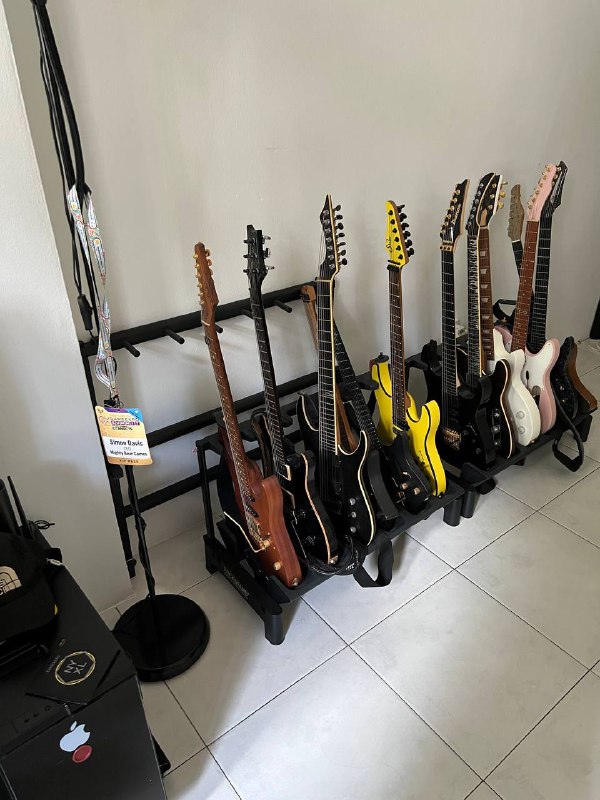
Before crypto, he was a professional guitarist who made ends meet by playing in metal bands and cover bands and by teaching guitar. But after his money dried up one summer, he scored a six-week gig as a professional game tester — and he’s never looked back.
Davis’ ever-growing guitar collection. (Simon Davis)During his time in the gaming industry, Davis has held management and product lead positions at gaming companies including King Digital Entertainment, Ubisoft, Bigpoint, AKQA, Empire Interactive, and Laughing Jackal.
In 2017, Davis teamed up with some friends and fellow industry veterans to launch Mighty Bear Games in Singapore, where they intended to focus on creating traditional games — before pivoting to blockchain in 2022. And in 2023, the firm launched an open beta for Mighty Action Heroes, its first Web3 gaming title.
Simon Davis is the co-founder and CEO of Mighty Bear Games, a multiplatform game developer in Southeast Asia creating accessible multiplayer experiences in Web3.
Davis has spent almost two decades working in the gaming industry, but he never planned to actually work in this field.
Before crypto, he was a professional guitarist who made ends meet by playing in metal bands and cover bands and by teaching guitar. But after his money dried up one summer, he scored a six-week gig as a professional game tester — and he’s never looked back.
Davis’ ever-growing guitar collection. (Simon Davis)During his time in the gaming industry, Davis has held management and product lead positions at gaming companies including King Digital Entertainment, Ubisoft, Bigpoint, AKQA, Empire Interactive, and Laughing Jackal.
In 2017, Davis teamed up with some friends and fellow industry veterans to launch Mighty Bear Games in Singapore, where they intended to focus on creating traditional games — before pivoting to blockchain in 2022. And in 2023, the firm launched an open beta for Mighty Action Heroes, its first Web3 gaming title.
Mighty Bear Games CEO Simon Davis — AKA “Papa Bear” — gave us a look inside his Web3 gaming studio, and his thoughts on the future of gaming.
Mighty Bear Games CEO Simon Davis — AKA “Papa Bear” — gave us a look inside his Web3 gaming studio, and his thoughts on the future of gaming.